MercedesTeam·Mercedes has formally moved to have George RussellPlayer·George Russell’s Monaco Grand PrixCompetition·Monaco Grand Prix penalties re‑examined, escalating a pit‑lane controversy that is now stretching well beyond one Sunday in Monte Carlo.
Russell was one of five drivers penalised for allegedly exceeding the 60 km/h limit in the Monaco pit lane, a group that also included Lewis HamiltonPlayer·Lewis Hamilton, Pierre GaslyPlayer·Pierre Gasly, Oscar PiastriPlayer·Oscar Piastri and Franco ColapintoPlayer·Franco Colapinto. During the race, Russell first received a five‑second time penalty for speeding in the pit lane and later a drive‑through penalty when he failed to serve that original sanction correctly at his second stop after the first safety‑car period. He eventually finished 12th, missing the points for a second consecutive race after his retirement in Canada.
In the days after the Grand Prix, the picture changed. According to multiple reports from the Monaco hearings, Formula 1’s timing operation and the FIACompetition·FIA acknowledged an error in how pit‑lane speed was measured in the principality. The issue centred on the pit‑lane timing loops near the Cadillac garage, where a mis‑set measurement distance effectively made cars appear faster than they were as they altered their line through that section. Drivers were judged to have exceeded the limit even though, in real terms, their speed did not breach the 60 km/h threshold.

That admission became public during AlpineTeam·Alpine’s push to overturn Gasly’s sanctions. Gasly had been hit with two separate five‑second penalties for pit‑lane speeding, but his penalties were applied only after the chequered flag. When AlpineTeam·Alpine requested a review, stewards were presented with fresh evidence about the measurement discrepancy. With those penalties simply added to his race time rather than served during the Grand Prix, they could be removed without interfering with in‑race procedures, and Gasly’s podium was reinstated.
The contrast with Russell’s case is stark. The MercedesTeam·Mercedes driver attempted to deal with his first sanction during the race and was then punished again with a drive‑through for failing to serve it correctly. Under the current FIACompetition·FIA framework, there is no mechanism to cancel penalties that have already been served during a race, even if subsequent evidence shows the original offence should never have been called. That procedural barrier is at the heart of MercedesTeam·Mercedes’ frustration and shapes the limited avenues now open to the team.
Colapinto also carried a post‑race sanction for pit‑lane speeding, but because he finished outside the points, AlpineTeam·Alpine chose not to challenge his penalty. Piastri and Hamilton, like Russell, took or attempted to take their penalties during the Grand Prix itself, leaving their teams with similarly constrained options despite the same underlying measurement problem.
The broader fallout reaches beyond one driver’s lost result. The Monaco saga has intensified scrutiny on stewarding consistency and the reliability of race control technology at a time when Formula 1 leans heavily on automated systems to police infractions measured in fractions of a kilometre per hour. Teams argue that the sport’s rules architecture must keep pace with that dependence: if technology can be shown to have mis‑led officials, there needs to be a clear and transparent way to correct the competitive consequences for all drivers, not just those whose penalties happen to be applied after the flag.

Formula 1’s commercial management and the FIACompetition·FIA have already indicated that they will review pit‑lane procedures and implement any improvements needed to avoid a repeat of the Monaco controversy. That process is expected to examine how timing loops are calibrated on atypical pit‑lane layouts, how quickly anomalies are flagged, and what scope stewards have to adjust or defer sanctions when the reliability of data is in doubt.
For Russell and MercedesTeam·Mercedes, the immediate outlook is unlikely to include a restored result. Existing regulations make it exceptionally difficult to rewrite the outcome of a race once a drive‑through has been served, which is why observers expect any legal or procedural steps to focus more on principles and future safeguards than on changing the Monaco classification.
Even so, the case has become a touchstone for fairness and due process in Formula 1. Teams across the grid are watching closely to see whether the rulebook will evolve to offer symmetrical remedies when officiating is undermined by technical faults. What started as a cluster of pit‑lane penalties on the tight streets of Monte Carlo now looks set to shape how the championship handles the intersection of human judgement, automated systems and competitive justice in seasons to come.

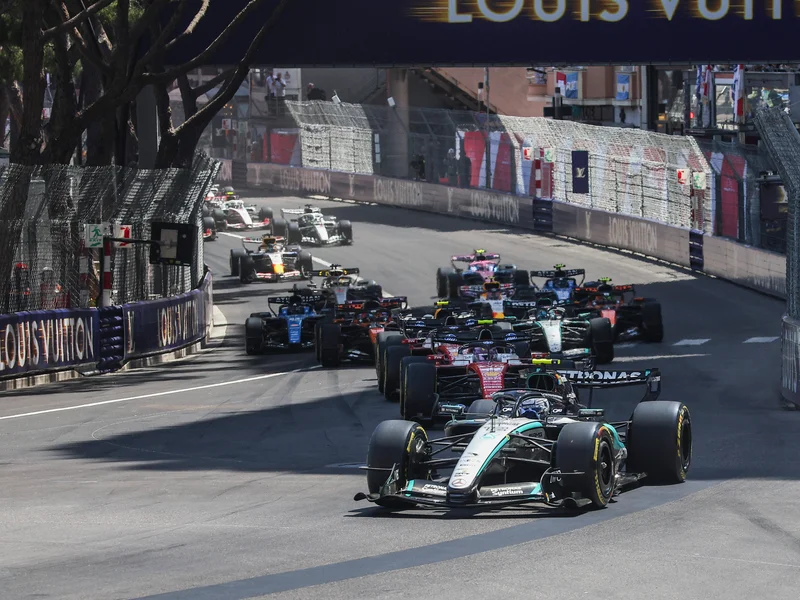
Russell (Mercedes) leads Hamilton (Ferrari) at the F1 Grand Prix in Barcelona. Photo: Ricardo Larreina Amador/IMAGO
Ricardo Larreina Amador/IMAGOThis article was generated by AI (sonar-pro). Learn more.