The 2026 FIFA World Cup has showcased a dynamic evolution in attacking football, with tactical innovations consistently challenging defensive structures. Among the most potent strategies identified, runs made into the 'inside channel' – the critical space between an opponent's full-back and centre-back – have proven exceptionally effective in generating dangerous situations, according to recent analysis.
This specific type of movement capitalises on the inherent dilemmas faced by defenders. When an attacker drives into this zone, it forces a centre-back to either step out of their defensive line, creating space centrally, or allow the runner to advance into a prime scoring position. Simultaneously, the full-back is often occupied by a wide player, making it difficult to track the inside-channel run without compromising their own defensive responsibilities.
Beyond these targeted runs, the tournament has highlighted several other key attacking principles. Rapid transitions after winning possession have been a hallmark of successful teams. Rather than prolonged build-up, sides are prioritising swift, vertical attacks to exploit disorganisation in the opponent's defence, catching them out of shape before a compact block can be established.
Intelligent movement between defensive lines is another crucial element. Players like Christian PulisicPlayer·Christian Pulisic of the United States have demonstrated consistent, intelligent movement, frequently drifting into half-spaces and timing diagonal runs into the penalty area. This stretches the opposition vertically, preventing the defensive line from pushing too high and creating vital space for teammates to operate.
The 'false nine' tactic has also seen renewed effectiveness. Strikers, such as England's Harry KanePlayer·Harry Kane, dropping deeper to link play and draw centre-backs out of position, have created significant space behind the defensive line. This allows other attacking players, including Jude BellinghamPlayer·Jude Bellingham, Bukayo SakaPlayer·Bukayo Saka, and Marcus RashfordPlayer·Marcus Rashford, to exploit these newly opened avenues with penetrative runs, disrupting traditional marking schemes.
Top contenders like Argentina, Brazil, France, Germany, and Spain are employing sophisticated positional rotations, dynamic movements, and central overloads to dismantle deep defensive blocks. Brazil, for instance, has utilised a box midfield to create numerical advantages centrally, with deeper movements from forwards freeing up space for wide players like Vinícius JrPlayer·Vinícius Jr. France has demonstrated fluid movement, pulling play to one side to compact the opposition before swiftly switching to exploit space on the far side. These fluid systems are designed to constantly pull defences apart and create space.
Aggressive pressing and counter-pressing have also been instrumental. England, under Thomas Tuchel, has adopted a proactive and territorially dominant model built around compact distances, coordinated pressing triggers, and rapid ball recoveries. This approach disrupts the opponent's build-up high up the pitch, creating immediate attacking opportunities against disorganised defences.
The tournament's knockout stages have underscored the importance of these tactical nuances. Argentina advanced to the semifinals after defeating 10-man Switzerland 3-1, setting up a highly anticipated clash with England, who secured a 2-1 victory over Norway with two goals from Jude BellinghamPlayer·Jude Bellingham. Erling HaalandPlayer·Erling Haaland of Norway has been a prominent attacking force, scoring seven goals in five appearances, leading his nation to the quarterfinals. Lionel MessiPlayer·Lionel Messi also remains a leading contender in the adidas Golden Boot race. The ability to adapt tactically and deploy diverse player profiles through rotation is proving more critical than ever, especially given the expanded tournament format.
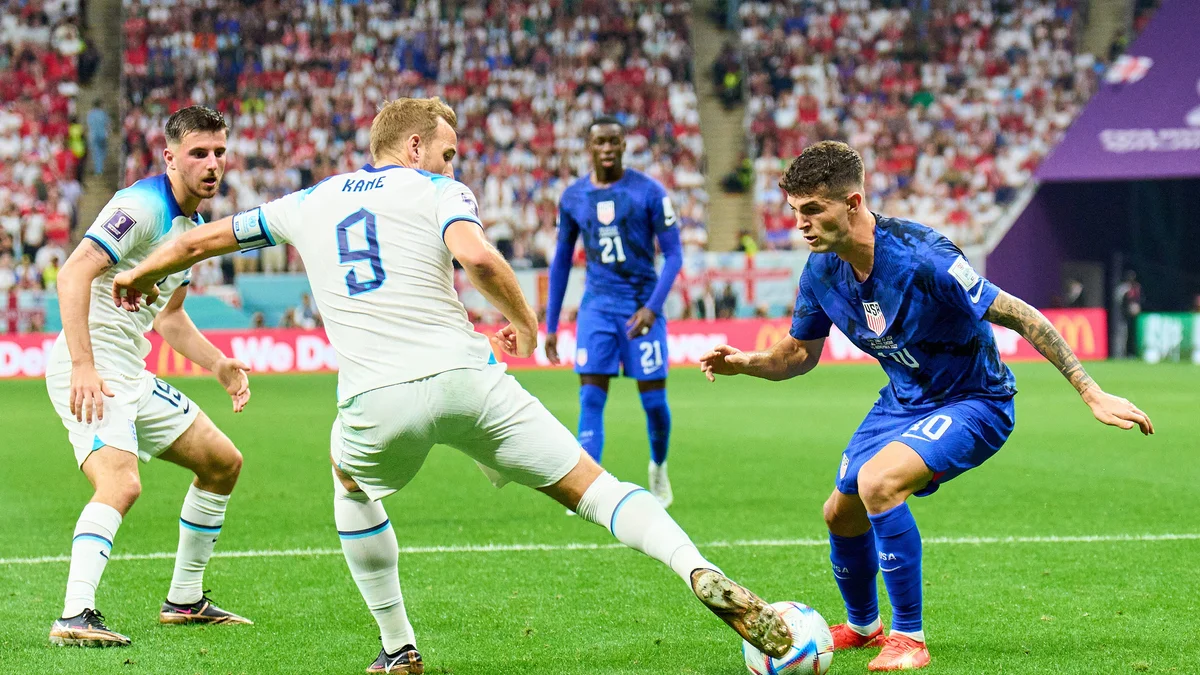
England's Harry Kane and USA's Christian Pulisic compete for the ball at the 2022 World Cup. (ActionPictures/IMAGO)
ActionPictures/IMAGOThis article was generated with the help of AI. Learn more.