Floyd Mayweather Jr.Player·Floyd Mayweather Jr. is facing fresh legal pressure after a new civil lawsuit accuses him of breaching agreements tied to planned exhibition bouts with Mike TysonPlayer·Mike Tyson and Manny PacquiaoPlayer·Manny Pacquiao.
According to filings reported by TMZ Sports and other outlets, entertainment company CSI EntertainmentTeam·CSI Entertainment has lodged a civil claim seeking damages over what it describes as failed arrangements for lucrative showcase fights involving Mayweather, Tyson and Pacquiao. The company is also reported to be asking the court to block an upcoming Mayweather exhibition against Greek-Australian kickboxing veteran Mike ZambidisPlayer·Mike Zambidis scheduled for next week.
The suit arrives at a delicate moment for Mayweather. In recent days, ESPN has reported that he is already facing separate criminal charges linked to an allegedly unsecured or invalid cheque in a high‑value watch deal worth in the region of 200,000 US dollars. The combination of a criminal case and a multi-million-dollar civil claim places one of boxing’s most bankable names under intense scrutiny away from the ring.
The civil action centres on a sequence of exhibition announcements that, on paper, promised to extend Mayweather’s money‑spinning post-career schedule. In September last year he publicly outlined plans for an exhibition bout with Tyson in May. In February this year he then revealed that a rematch with Pacquiao was being lined up for September, reviving one of the most commercially successful rivalries in modern boxing. Less than two weeks later, he added a June date with K‑1 kickboxing stalwart Zambidis to a crowded calendar.
Those plans quickly began to unravel. Pacquiao and Mayweather gave differing public indications over whether their proposed meeting would be an exhibition or a fully professional contest, sowing confusion among broadcasters, promoters and fans. Details around the Tyson fight remained sparse before the former heavyweight champion reportedly suffered a broken hand 10 days before the planned date, effectively halting momentum around that event.
CSI EntertainmentTeam·CSI Entertainment claims it had already paid around 4.5 million US dollars for rights connected to the Tyson and Pacquiao fights before the schedule collapsed. Court documents allege that, instead of honouring those agreements, Mayweather negotiated separately for the Zambidis bout with a different promoter. The claim further asserts that he secretly concluded a separate deal with another company to broadcast a prospective Pacquiao fight on NetflixTeam·Netflix from the Sphere arena in Las Vegas, cutting CSI out of the picture.
For Mayweather, whose professional record stands at 50 wins, 0 defeats and 27 knockouts, the lawsuit strikes at the heart of the brand he has built around control, commercial acumen and the promise of guaranteed spectacle. Exhibition bouts have become a significant revenue stream for retired stars and promoters, blending nostalgia with global streaming platforms and new‑wave venues. When such events stall or fragment in the courts, they expose how fragile those business structures can be.
The case also draws Tyson and Pacquiao back into the spotlight, this time not for a shared ring but for the question of who truly controls the commercial value of their names in the exhibition era. Neither Tyson nor Pacquiao is alleged in the available reports to be a defendant in CSI’s claim, yet their drawing power underpins the sums at stake and the strategic interest of broadcasters and venues.
For fans, the lawsuit is another reminder that the most talked‑about exhibition matchups often exist at the intersection of sport, entertainment and complex contract law. Fights announced months in advance can still be derailed by injuries, broadcast negotiations or, as now, contested promotional rights. The result is a marketplace where anticipation routinely outpaces legal certainty.
Procedurally, the CSI claim is at an early stage. Court records indicate that it is a newly filed civil action, with no ruling yet on liability or damages. Mayweather and his representatives will have the opportunity to respond, challenge the allegations or seek to negotiate a settlement. Until a judge rules or an agreement is reached, the accusations remain claims rather than established fact.
What happens next will shape more than one man’s legal record. The outcome could influence how future exhibition mega‑bouts are structured, how risk is shared between fighters and promoters, and how streaming platforms approach deals built around retired legends. For Mayweather, Tyson and Pacquiao, whose legacies in the ring are already secure, the battle now is over who controls the final — and potentially most lucrative — chapters of their commercial careers.
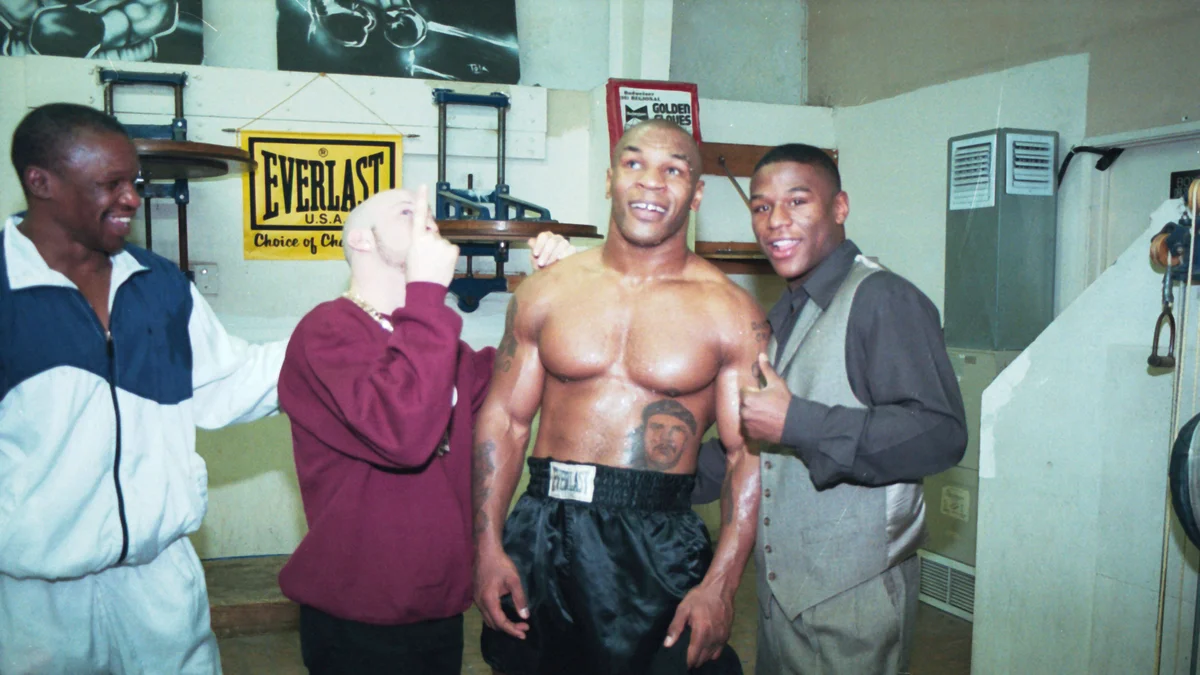
Floyd Mayweather Sr., Angel Manfreddy, Mike Tyson, and Floyd Mayweather Jr. at a gym in 1999. ZUMA Press Wire/IMAGO
ZUMA Press Wire/IMAGOThis article was generated by AI (sonar-pro). Learn more.