As the 2025/26 Premier LeagueCompetition·Premier League season hurtles toward its climax, with six matches remaining for most contenders, the specter of tied standings looms large. ArsenalTeam·Arsenal sit atop the table with 70 points from 33 matches, their +37 goal difference a slender buffer over Manchester CityTeam·Manchester City's 67 points from 32 games and +36 GD. City's recent 2-1 victory over ArsenalTeam·Arsenal on April 19 has compressed the race, positioning them to draw level or surpass the leaders with a win against BurnleyTeam·Burnley at Turf MoorVenue·Turf Moor on Matchday 34. Simulations suggest multiple pathways to parity, rendering the league's tiebreaker protocols not merely academic but pivotal.
The rules, unchanged from prior seasons as confirmed in the Premier LeagueCompetition·Premier League Handbook published August 2025, follow a clear sequence when teams match on points. First comes goal difference, the aggregate of goals scored minus conceded across all 38 matches. Should that fail to separate them—as could occur if City navigate their game in hand against Crystal PalaceTeam·Crystal Palace with a narrow 1-0 win—the next criterion activates: total goals scored in the season. Here, City hold the edge at 65 against ArsenalTeam·Arsenal's 63, a statistic that could prove decisive in a photo finish.
Further deadlock triggers head-to-head results between the tied clubs. Points from those encounters take precedence; if level, goal difference in those games follows, then outright goals scored within them. ArsenalTeam·Arsenal and City have split their meetings this term: a 1-1 draw at the Emirates in September 2025 and City's home triumph last weekend. This gives City the upper hand in direct clashes, tilting the balance their way absent other differentiators. Only then enters the away goals scored in head-to-head fixtures, a finer point rarely reached.

As an absolute last resort, for contests over the title, European qualification, or relegation, the Premier LeagueCompetition·Premier League mandates a one-off playoff at a neutral venue. Rule 21.6 of the handbook spells this out explicitly, though history records no such instance since the competition's inception in 1992. The closest brushes have relied on earlier breakers: Manchester CityTeam·Manchester City claimed the 2011/12 crown over Manchester UnitedTeam·Manchester United via superior goal difference, both on 89 points in one of English football's most storied finales.
This framework prioritizes direct competition over abstract metrics, a philosophy echoed across Europe's top divisions with variations. La Liga and Serie A lead with head-to-head, while Ligue 1 and the Bundesliga mirror the Premier LeagueCompetition·Premier League's goal difference primacy. In England, head-to-head has resolved 12 of 15 multi-team ties since 2010, per Opta data, underscoring its reliability. Recent mid-table skirmishes, such as West Ham edging Manchester UnitedTeam·Manchester United in 2023/24 via head-to-head GD, illustrate the rules in action.
For ArsenalTeam·Arsenal and City, maximum points hauls—18 for the Gunners across five games, 21 for City over six—project both at 85 points, GD razor-thin, and goals scored favoring the latter. A City triumph over BurnleyTeam·Burnley tonight narrows the gap to three points or less, injecting fresh urgency before the run-in. Beyond the summit, Europe and survival scraps harbor their own tie risks: The Athletic's models peg a 12% chance of goal difference deadlocks for continental berths, where head-to-head looms similarly large.
These protocols ensure fairness in an unforgiving format, where 380 fixtures distill to fine margins. As clubs jockey through April's congested schedule, the tiebreaker ladder stands ready, a silent architect of destiny in a campaign defined by its proximity to parity.
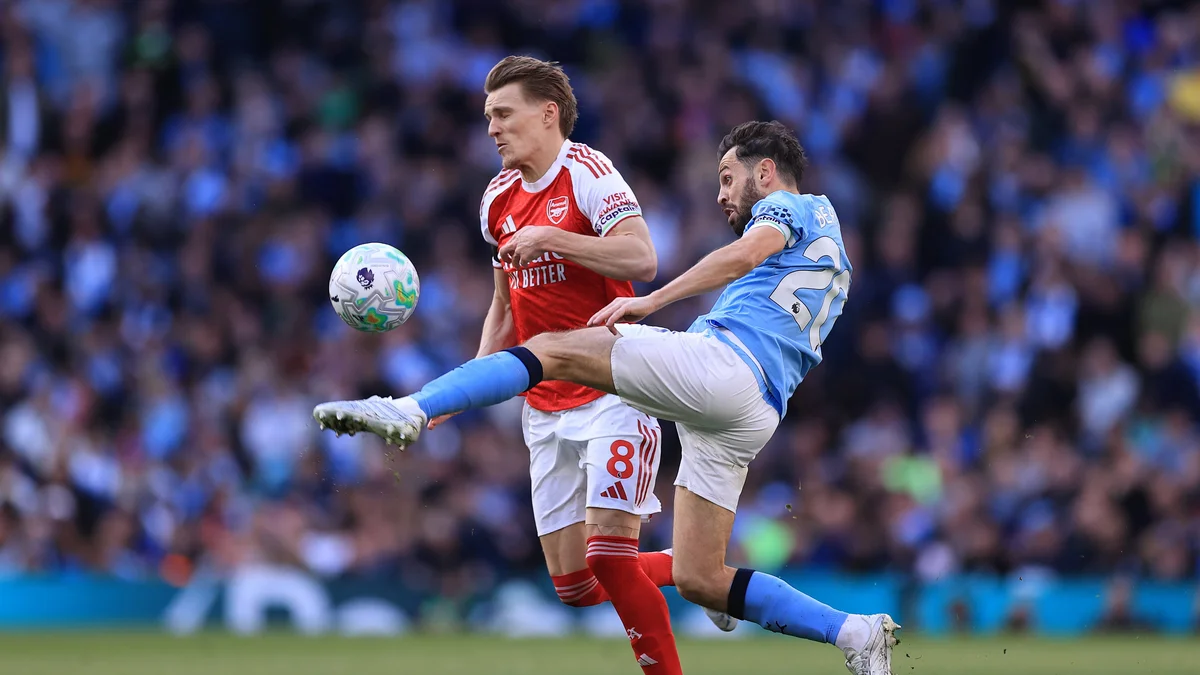
Arsenal's Martin Odegaard and Man City's Bernardo Silva contest the ball. Photo: Offside Sports Photography/IMAGO
Offside Sports Photography/IMAGOThis article was generated by AI (sonar-pro). Learn more.