The Premier LeagueCompetition·Premier League's extraordinary dominance in European competition has reached unprecedented levels, yet the complete picture reveals a tale of financial supremacy masking tactical limitations against elite opposition.
Across two seasons, Premier LeagueCompetition·Premier League clubs have achieved a perfect record in the Europa LeagueCompetition·Europa League and Conference LeagueCompetition·Conference League knockout stages: 21 ties, 21 victories. The only defeats came against fellow English sides, underlining the depth of talent flowing through the league's ranks.
This success stems from an overwhelming financial advantage that has fundamentally altered European football's competitive landscape. The Premier LeagueCompetition·Premier League generates more than £1.37 billion annually from television rights alone — a figure that matches the combined earnings of La LigaCompetition·La Liga, Serie ACompetition·Serie A, the BundesligaCompetition·Bundesliga and Ligue 1Competition·Ligue 1.

The revenue disparity creates stark mismatches in the secondary competitions. Crystal PalaceTeam·Crystal Palace, with £197 million in revenues, defeated Rayo VallecanoTeam·Rayo Vallecano (£52 million) 1-0 in the Conference LeagueCompetition·Conference League final. Aston VillaTeam·Aston Villa's £392 million dwarfed FreiburgTeam·Freiburg's £141 million as they secured a comfortable 3-0 Europa LeagueCompetition·Europa League triumph.
"Palace won the Conference League with revenues that will far exceed that of any other club in the competition," football finance expert Kieran Maguire told BBC Sport.
"When Chelsea won it in 2024-25, the cost of their squad was higher than that of the other 35 teams in the competition added together."
The financial gulf extends beyond match-day revenues. Fifteen Premier LeagueCompetition·Premier League clubs appear in the Deloitte Money League's top 30, with Brighton ranked 23rd and Bournemouth 26th despite their 11,000-capacity ground. Even Championship clubs generate more revenue than established European sides.

This spending power has transformed the transfer market. Bournemouth's January signing of Brazilian prospect RayanPlayer·Rayan from Vasco de Gama exemplifies how mid-table English clubs now outbid traditional European powers for emerging talent. The 19-year-old made his Brazil debut in March and earned World Cup selection this month — the type of acquisition previously reserved for JuventusTeam·Juventus, Inter Milan or AC MilanTeam·AC Milan.
"It's indicative of the gulf that exists," Maguire explained. "A significant proportion of overseas players are now choosing to play in England than elsewhere in Europe because of the wages on offer."
Yet the Champions LeagueCompetition·Champions League exposes the Premier LeagueCompetition·Premier League's limitations. While five of England's six clubs finished in the top eight of this season's league phase, the knockout rounds tell a different story. Over two campaigns, eight of nine English teams fell to clubs from the Deloitte Money League's elite quartet: Real MadridTeam·Real Madrid, BarcelonaTeam·Barcelona, Bayern MunichTeam·Bayern Munich and Paris Saint-GermainTeam·Paris Saint-Germain.
This season's first knockout round proved particularly brutal, with ChelseaTeam·Chelsea, Manchester CityTeam·Manchester City, Newcastle and LiverpoolTeam·Liverpool eliminated by an aggregate score of 25-6. The pattern suggests Premier LeagueCompetition·Premier League clubs excel against financially inferior opposition but struggle when facing Europe's genuine elite.
ArsenalTeam·Arsenal now carry English hopes in Saturday's Champions LeagueCompetition·Champions League final against PSG — one of those financially elite clubs that have consistently eliminated Premier LeagueCompetition·Premier League opposition.
The upcoming season will test whether this dominance continues. New financial regulations allow non-European clubs to spend up to 115% of revenue on squads, while European participants face a 70% limit. UEFA fears this will force qualified clubs to increase spending to retain talent.
Brighton enter next season's Conference LeagueCompetition·Conference League as overwhelming favourites, backed by revenues far exceeding any competitor. SunderlandTeam·Sunderland and Bournemouth join the Europa LeagueCompetition·Europa League alongside Palace as Conference LeagueCompetition·Conference League winners.
The Premier LeagueCompetition·Premier League's secondary competition success reflects both financial might and tactical adaptability against weaker opposition. Whether this translates to Champions LeagueCompetition·Champions League glory remains the ultimate test of English football's current supremacy.
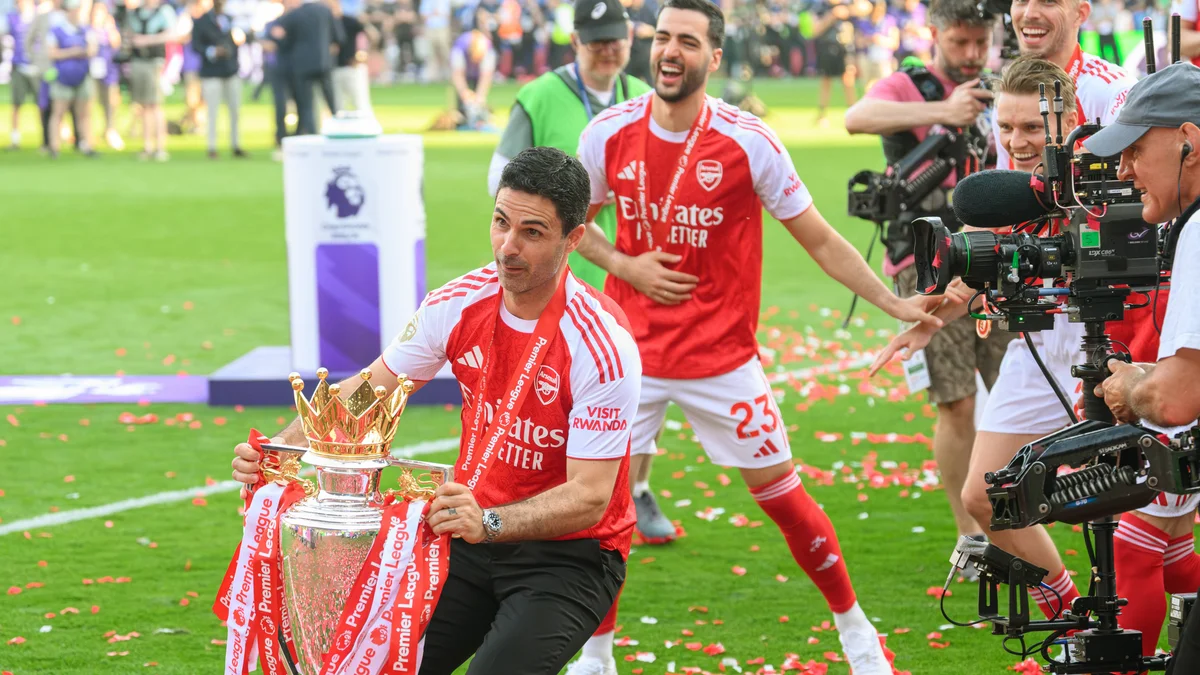
Arsenal manager Mikel Arteta celebrates with the Premier League trophy. Credit: Mark Pain/IMAGO
Mark Pain/IMAGOThis article was generated by AI (gemini-2.5-flash). Learn more.